 Zoom
Zoom
Photo: Lisa Rastl 2 images
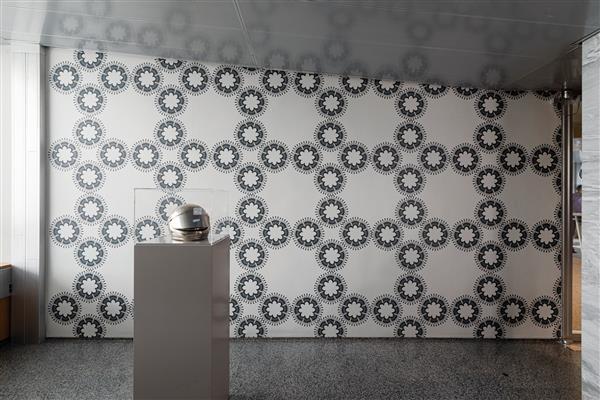
THE DAY I KILLED ELVIS (Wallpaper)
Elisabeth Bakambamba Tambwe
wallpaper; digital print with a digitally edited photo as original source
dimensions variable
2020
Commission 2020
Inv. No. WP_19
on loan
In The Day I Killed Elvis, Elisabeth Bakambamba Tambwe presents hundreds of miniature self‑portraits. Adopting the stance of a cowboy and referencing Andy Warhol’s Double Elvis, she points a revolver directly at the viewer. Through the circular multiplication of the figure in an irregular sequence, the image evokes associations with kaleidoscopes, bobbin lace, rotating cogwheels, or Gothic architectural ornament. In its wallpaper‑like configuration, the motif relinquishes heroic singularity and instead acquires a rhythmic, almost ornamental quality.
The iconic cowboy—an emblem of Western masculinity, violence, and myth—is displaced through Tambwe’s act of self‑appropriation and critically reframed from a feminist perspective. Repetition and seriality function not merely as decorative devices but as central mechanisms of meaning production. The wallpaper becomes a pictorial surface that mediates between individual identity and collective visual memory, while simultaneously structuring the surrounding space. The logic of repetition follows a fractal structure: the image multiplies and occupies the visual space, while the repeated body remains present and disrupts the perception of the decorative surface. The seemingly floral structure expresses a critical interrogation of representation, visibility, and power. The fractal functions less as a formal principle than as a strategic tool.
Born in Kinshasa, Tambwe studied fine art and sculpture in Lille and now lives and works in Vienna. Her choreographic works and performances, in particular, engage the body as a site of visibility, attribution, and cultural coding. Across media, her practice is characterized by a confident engagement with quotations drawn from art history, popular culture, and political iconography. By intertwining autobiographical perspectives with global image economies, she interrogates dominant narratives of identity and representation.
Within this context, the wallpaper does not function as a passive background but as a narrative field. The transformation of Elvis Presley into a self‑portrait of the artist operates as a gesture that is at once humorous and disarming. Presley, long celebrated as the first megastar of a musical genre rooted in African American culture, becomes a vehicle for addressing appropriation and authorship. Through serial repetition, Tambwe generates a field of tension—between woman and man, individual and mass, empowerment and media‑driven multiplication—inviting viewers to reconsider familiar modes of seeing and to confront the power structures embedded in images.
Heike Maier-Rieper, 2026
Translation AI generated
Continue readingExhibitions
Tapeti. Wallpaper and Artworks from the Museum of Contemporary Art Skopje and evn collection, Museum of Contemporary Art Skopje , Skopje, 2026
Wallpaper #4, evn sammlung, Maria Enzersdorf, 2020
Publications
Wallpaper #4, Wien 2021, p. 3, 7–13 (s. p.)
Context
More works
from Elisabeth Bakambamba Tambwe
More Wallpapers

More works
from 2020
More works
ornaments
More works
self-portraits