 Zoom
Zoom
Photo: Tolia Astakhishvili 5 images
Spaces about other Spaces
Tolia Astakhishvili
wallpaper, digitally printed, in five variants
variable
2025
Commission 2025
Inv. No. WP_35
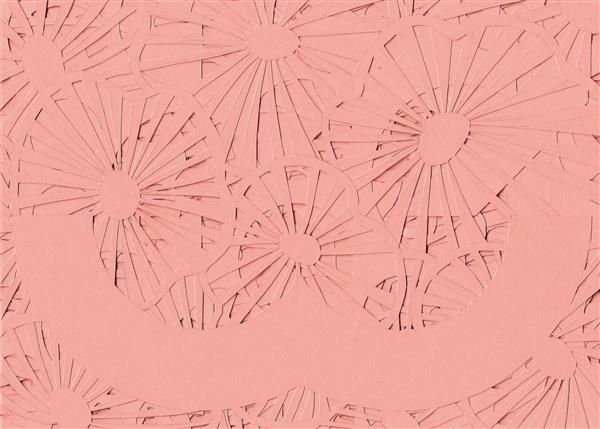
A few images can be discerned on a wallpaper. They are reproductions of paintings by her grandfather, surrounded by a repeated lily motif on a blue background. In this setting, the paintings appear like quotations, highlighted by illusionistic frames and at the same time flattened, merged with the background—both present and distant.
Tolia Astakhishvili grew up in her grandfather’s studio, in a house in Tbilisi, Georgia. The roughly 250 m² house was a network of living and working spaces in which life and art blended seamlessly. The house was created with three artists and the wallpaper with golden lilies decorated one of the workrooms. In the 1930s, he was a well-known artist who, despite the isolation of the Soviet art scene and political restrictions, succeeded in developing an independent artistic voice. Astakhishvili’s revival of his work is therefore not only an act of private remembrance but also a contribution to the art history of modernism.
Astakhishvili recounts how, as a seven-year-old girl, she painted together with her grandfather or leafed through his books when he was absent. Each room had its own color. The dining room was a rich green, the showroom was a salon‑like space with blue wallpaper patterned with lilies and lit by a single window. In contrast, the studio was a true working studio—crowded with paintings, materials, and tools, its walls a muted grey. In these distinct atmospheres, early impressions took shape—impressions that would later return as motifs and formative ideas in her work.
In this stillness and atmosphere, early experiences took shape—experiences that later return as motifs and formative ideas in her work.
The lily wallpaper becomes an occasion for remembrance, a kind of afterlife of the images, like the formation of light as a contrasting medium of what once was. Added to this is the repetition of the motif, which resembles an updating, a revival of what is threatened by forgetting. Astakhishvili describes: “I only have one photograph of the wallpaper, and yet the idea of revisiting it has accompanied me for many years. In my memory, it is never static. It always appears at the edge, in peripheral vision, a constant background that is constantly changing.” Memory does not preserve images; it animates them, continually re-actualizes them, shifting scale, perspective, and effect. Even present-day seeing is overlaid by this afterlife of images, permeated by the resonance of earlier impressions.
For this reason, Astakhishvili, who practices an art of forbearance, does not remain bound to the surface in her work. In fact, she has become known for precise spatial installations and in situ works. In them, spaces do not open up but rather become nested, sightlines blocked and views obstructed. In this way, it becomes perceptible how memory eludes completeness but simultaneously calls for completion—always filtered, enriched by perception, later experience, and interpretive consciousness. This is only consistent, for memory is psychological. It is not only image but also spatial relation, state of mind, smell, aura, and atmosphere. And although it also becomes spatial, what it conveys is only an apparent coherence. For inner images may seem expansive, like dreams, yet they remain fractured, shaped by repetitions, fanning out into fragments and the need to recall them again.
Thomas D. Trummer, 2026
(translation machine edited)
Continue readingExhibitions
Wallpaper #8 / Tolia Astakhishvili & Klaus Scherübel, evn sammlung, Maria Enzersdorf, 2025
Context
More works
from Tolia Astakhishvili
More Wallpapers
More works
from 2025
More works
flowermotifs