 Zoom
Zoom
1 image
Flesh
Hristina Ivanoska
variable
2026–2026
Inv. No. WP_38
on loan
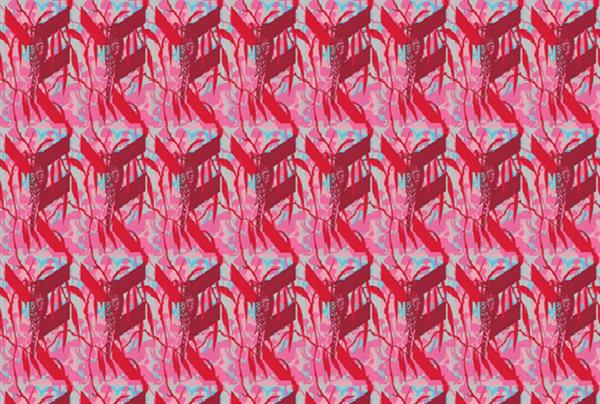
The wallpaper by Hristina Ivanoska emerges from an artistic practice deeply rooted in historical narratives, political realities, and social inquiry. Ivanoska works across disciplines—drawing, text, textile, installation, performance, and video—continually examining how individual experience is embedded within broader social and political structures. She lives and works between Skopje and Berlin and has exhibited internationally, including at Manifesta 14, MAXXI in Rome, and the Künstlerhaus in Vienna. This wallpaper refers to Ivanoska’s ongoing project Flesh into Blossom (2024–), conceptually provoked by her interest in the South Eastern European fairy figure, the Samovila, and Donna Haraway’s books A Cyborg Manifesto and Staying with the Trouble. She reimagines the fairy through a contemporary lens as a speculative, hybrid being, reflecting on how this folkloric entity might be understood today as a kind of future cyborg—echoing Haraway’s idea that the cyborg emerges precisely where the boundaries between human and animal dissolve. For the EVN Collection wallpaper Flesh, the artist employs her non-binary alphabet Archetype Open Form, a system that dismantles conventional hierarchies of vertical and horizontal lines. Instead, it constructs letters through circles, semicircles, and diagonals, deliberately resisting clear readability and opening up a space for poetic multiplicity.
The image is an homage to Ivanoska’s daily walks in Skopje City Park, where she experiences the ever-changing moods of nature and its quiet persistence. A distinctive detail is the image of the woodpecker. This fleeting acoustic encounter became the starting point for a visual motif. Here, the bird becomes a symbol of vitality, rhythm, and the living pulse of urban nature. Surrounded by mushrooms and willow branches, it exists within a layered ecosystem where subtle warnings of destruction remain embedded beneath the surface. Its presence within the wallpaper weaves together personal experience, the urban landscape, and a sense of an uncertain, unfolding future.
Overall, the wallpaper conveys a poetic tension between delicate, floral, and organic forms and the deliberately placed, almost documentary element of the bird. Combined with Ivanoska’s introspective and socially engaged artistic practice, the result is a work rich in both aesthetic and conceptual depth. It reveals the artist’s ability to transform everyday perceptions into a layered visual narrative. The wallpaper becomes a transitional space—a fine yet powerful weave of color, texture, and meaning, speaking of care, vulnerability, and the possibility of new interspecies relationships.
Heike Maier-Rieper, 2026
translation aided by a machine translation tool
Continue readingExhibitions
Tapeti. Wallpaper and Artworks from the Museum of Contemporary Art Skopje and evn collection, Museum of Contemporary Art Skopje , Skopje, 2026
Context
More works
from Hristina Ivanoska
More Wallpapers
More works
from 2026
More works
fairy-tale figures